
If a drawer catches on a potato masher every time you open it, the problem is not just clutter. The masher is taking up space the drawer needs to move. Before buying an organizer, take out what is causing the jam. Sorting the contents and measuring the drawer may be all you need.
Start with one drawer, not the whole kitchen
Pick the drawer that slows down an everyday task, such as finding a spatula while cooking or a clean teaspoon at breakfast. Empty it onto a clear counter and wipe out the crumbs. Let the drawer and its contents dry if either is damp. Doing one drawer at a time keeps the kitchen usable and makes it easier to decide where each item belongs.
Group the contents by function: everyday cutlery, cooking utensils, preparation tools, wraps and bags, linens, and miscellaneous items. Put things that belong elsewhere in a separate container and return them once the drawer is finished. Otherwise, trips across the kitchen can interrupt the sort.
Decide what earns drawer space
Ask whether each item works, how often you use it, and whether this is the right drawer for it. Keep duplicates when they serve a purpose: a second vegetable peeler may be useful in a busy household, but four blunt ones are unlikely to help. An empty compartment is not a reason to keep a tool.
- Keep in this drawer: Working items used regularly at the nearby counter, sink, or appliance.
- Move: Useful items that belong near a different task, or occasional equipment better suited to deeper storage.
- Repair or replace: Tools with loose handles, damaged grips, or worn working edges, if you still need them.
- Dispose of appropriately: Broken items, unusable packaging, and expired contents. Check local guidance for batteries and small electrical items.
If you are genuinely unsure about an item, put it in a small, dated container outside the drawer. Review it after several weeks to see whether you needed it, rather than leaving the undecided pile in everyday storage.
Assign drawers by task and reach
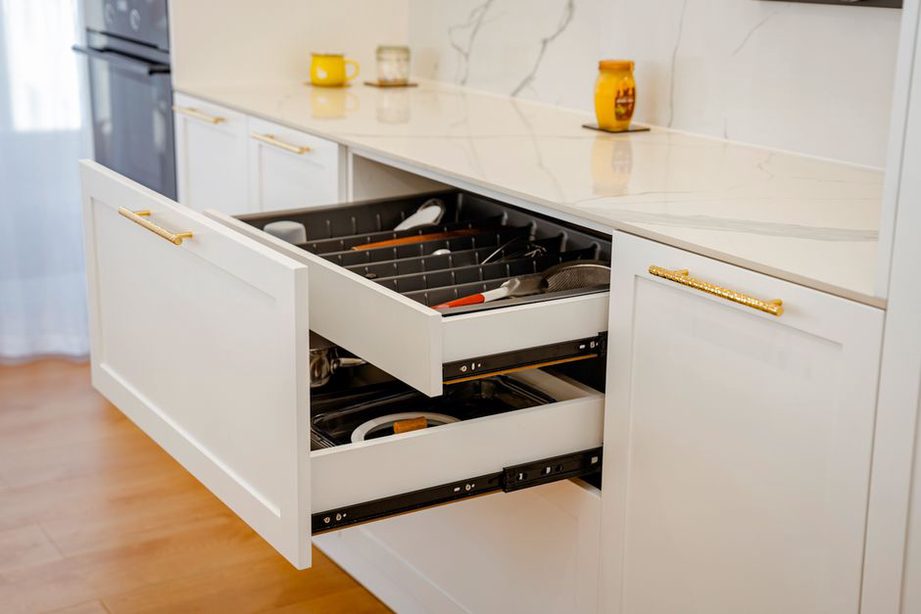
Organize drawers around what happens in the kitchen, rather than sorting items into categories for their own sake. Everyday cutlery belongs near where dishes are put away or meals are served. Cooking utensils should be close to the hob, but not where an open drawer gets in someone's way. Keep preparation tools near the counter used for cutting and mixing. The best positions depend on the layout and the people using it.
Give the easiest-to-reach drawers to items you handle often. Less-used tools can go in lower or more distant storage, as long as you can retrieve them without moving heavy objects. In a shared kitchen, a consistent spot for lunch-packing supplies can help; suitable dishes might go in a drawer a child can reach. Store sharp implements securely, not loose in an accessible drawer.
Check height as well as available floor area. A tall ladle can stop a shallow drawer closing even when there is empty space around it. Move long or bulky utensils to a deeper drawer or another suitable spot instead of forcing them under a cutlery insert.
Measure before choosing dividers
With the drawer empty, measure the usable inside width, front-to-back depth, and vertical clearance. Measure around obstructions: runners, protruding screws, and shaped drawer fronts can all reduce usable space. Check how far the drawer opens, too. An organizer may fit inside but leave its back compartments hidden beneath the counter overhang.
Choose compartments for the items you have decided to keep. Dividers should make categories easy to see and stop small things from mixing, without taking up most of the space themselves. Adjustable dividers help when tools vary in size. A shallow tray might hold teaspoons and forks; tongs or a whisk may need a longer section. Close and reopen the drawer to test the layout, leaving enough room for handles to settle without catching.
A non-slip liner can reduce movement and make cleaning easier, but it cannot make an overfilled drawer work. When items are packed to the drawer's full height, they can still ride over one another. Aim for a layout where you can put each tool away without shifting its neighbors.
Handle the problem categories deliberately
Cutlery and sharp tools
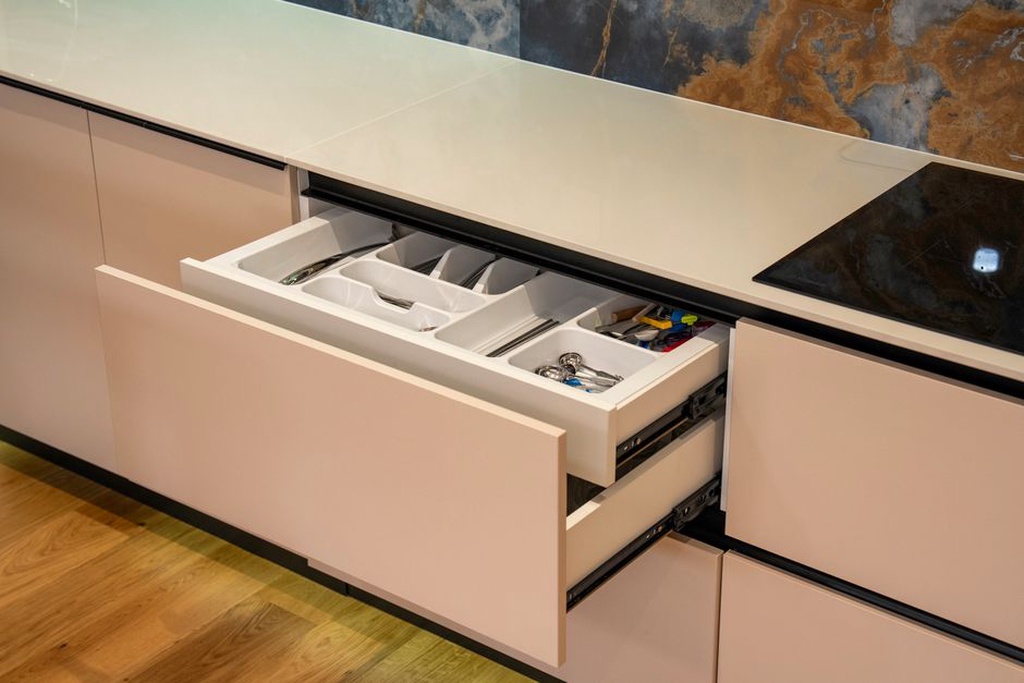
Keep frequently used cutlery together in a washable insert, with handles facing the same way so pieces are easy to pick up. Loose knives can damage the drawer and cut someone reaching inside. Use a fitted protective insert or suitable blade covers, and check that the drawer closes freely and the blades stay covered during normal use. Depending on the space and household, large knives may be better stored elsewhere.
Cooking utensils and gadgets
Lay out spatulas, spoons, tongs, whisks, and specialty tools before dividing the drawer. Compare items that do the same job: a rigid spatula and a flexible one may both earn their place, while several near-identical extras may just crowd it. Keep the most-used tools at the front. Occasional equipment can go farther back if you can lift it out without unloading the drawer.
Packets, wraps, and miscellaneous items
Small packets and loose accessories spread through a large compartment. Give each category its own section, and remove empty boxes or damaged packaging. Keep food-contact items away from cleaning chemicals. If the drawer has collected batteries, pens, fasteners, and takeaway cutlery, sort them by use and move items out of food-preparation storage where appropriate.
Check the finished drawer under normal use
Put the selected items back, then open and close the drawer several times. Nothing should scrape the cabinet above, snag at the back, or need to be held down. Take out and replace the things you would use for a typical meal. If a divider gets in the way, adjust it now, while you can still see everything.
Upkeep can be brief. Return stray tools to their assigned drawers when putting dishes away, and wipe up crumbs or spills when you notice them. When a new utensil comes in, check whether an older duplicate still gets used. If one category repeatedly overflows, reconsider its location or how many items you keep instead of adding another tray.
Finally, put a washed spatula away exactly as you normally would. If its handle prevents the drawer from closing, give it a longer compartment or a deeper storage spot before returning the rest of the utensils.